MarketClock — Trading Days API

2026 · Full-stack · Flask + Next.js · Market data
Every trading day, every settlement date.
MarketClock answers the questions a trading desk or back office asks every morning: is this exchange open today, does it close early, and when does a trade bought today actually settle? It covers the 30 exchanges and financial markets in the open-source holidays library, from the NYSE and Nasdaq to the London Stock Exchange, Tokyo, Hong Kong and Tadawul, each with its own weekend. It shows whether a market is open right now with a countdown to the close, works out T+1 and T+2 settlement dates across several markets at once, and checks the library's dates against the calendars the exchanges publish themselves.

- 30
- markets
- 66
- official days checked
- 210
- automated tests
- 100%
- core branch coverage
Built in October 2026 across 24 pull requests: a pure-Python date layer on the holidays library with 100% branch coverage, a Flask API with Pydantic validation, MySQL for sourced settlement cycles and official calendars, and Redis for caching and rate limiting. The Next.js web app has a page per market and year, a yearly index of every exchange, settlement, overlap and business-day calculators, calendar subscriptions, an embeddable status card and a data-quality page. Every fact that doesn't come from the library, a session hour, a settlement cycle, an official holiday, carries the link to the page it was read from. 172 backend and 38 frontend tests run on every pull request.
- 01
Sourced, not guessed: settlement cycles, trading hours and official calendars are stored with the exchange or regulator page they came from, and a market with no confirmed source says so instead of inventing an answer.
- 02
Checked against the exchange: NYSE, Nasdaq and London Stock Exchange calendars were compared day by day with the library, 66 official days in all, and every one matched.
- 03
Open right now: each market's state is worked out in its own time zone, with a countdown to the close or the next open, including early closes before holidays.
- 04
Settlement that respects history: a trade dated 2020 settles on the old T+2 rule and a trade dated today on T+1, because cycles are stored with the date they took effect.
Screens · MarketClock
Inside the build.
Web app
Home — a live globe of the exchange cities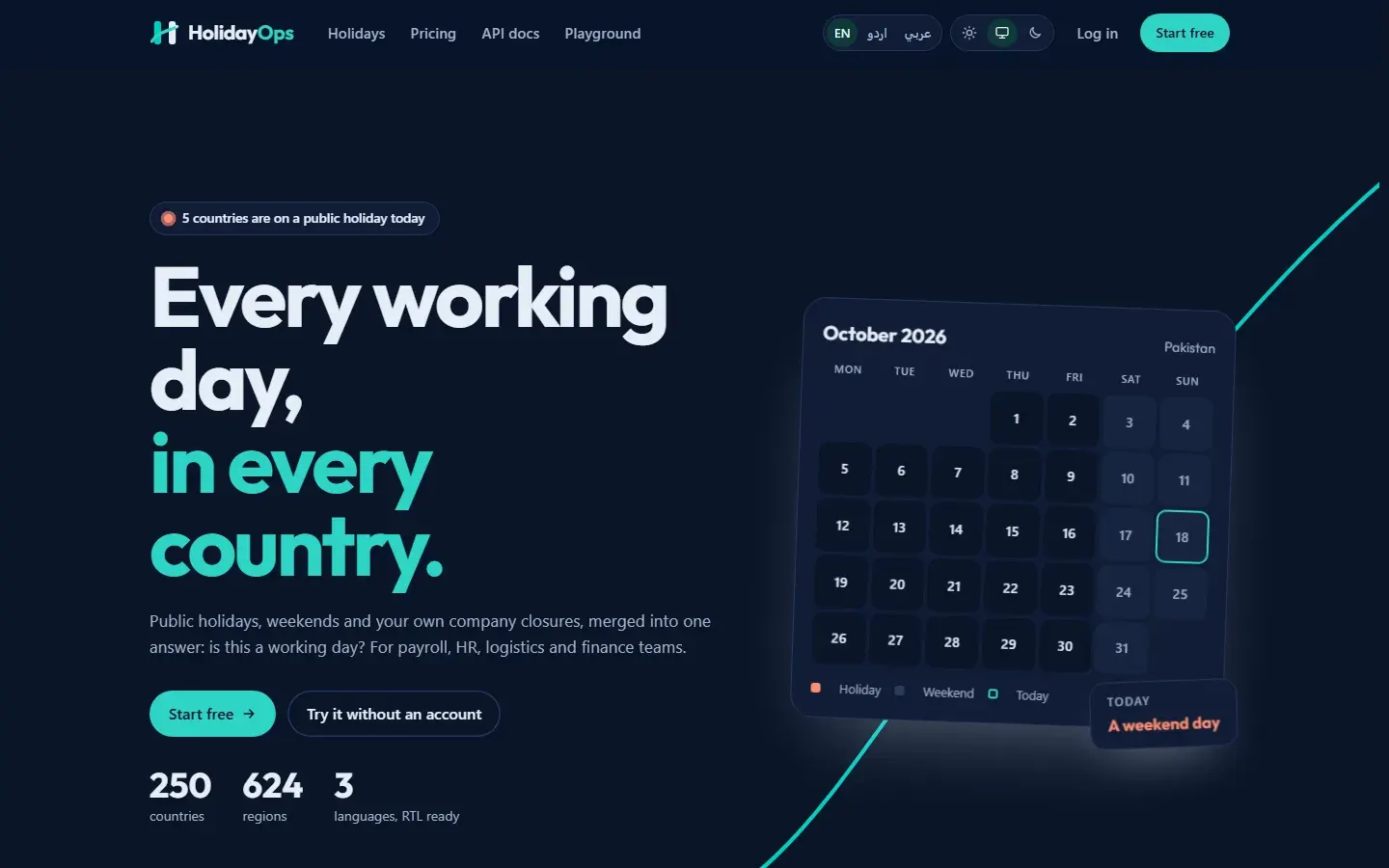
 HolidayOps
Every working day, in every country.